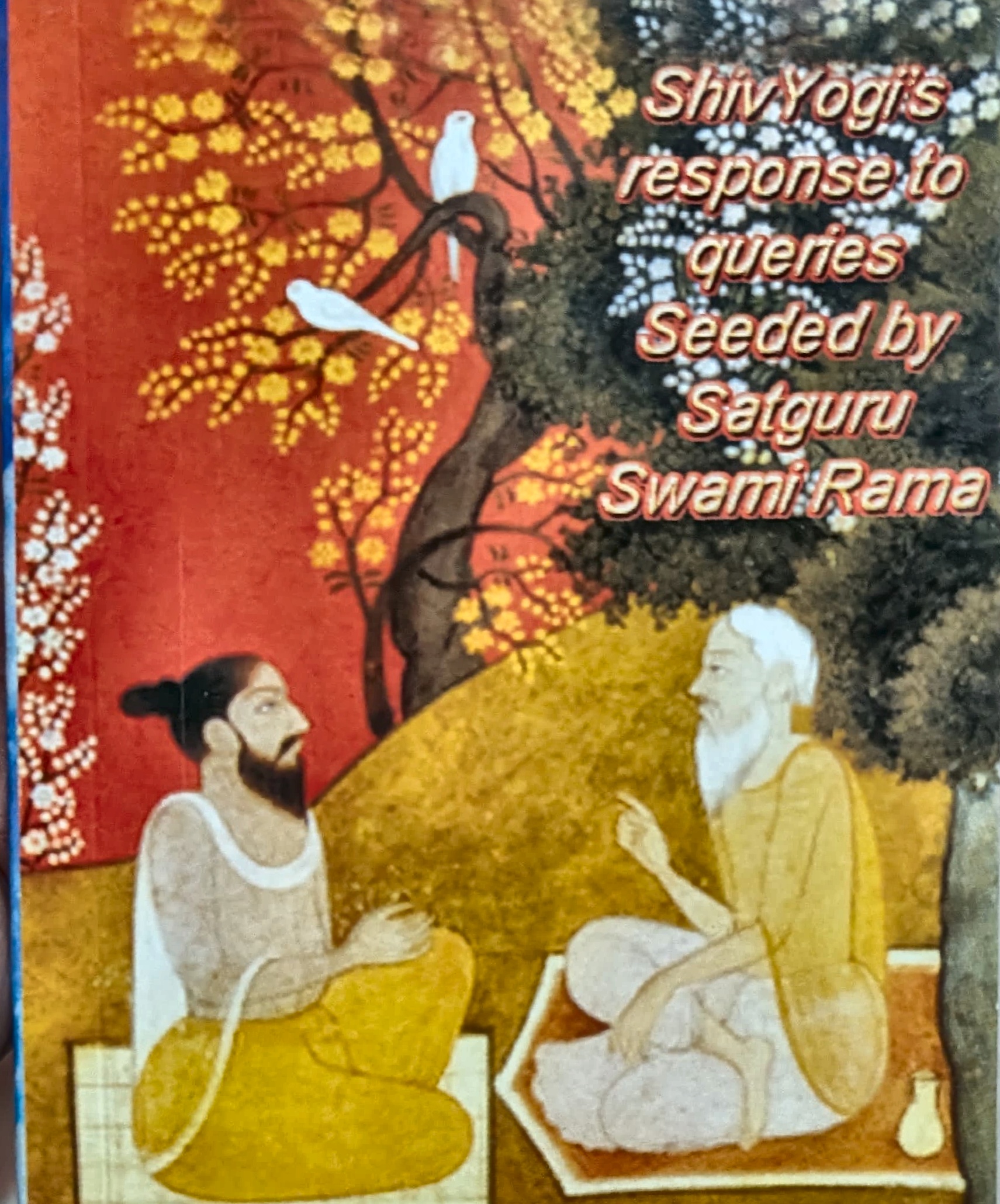
Archival discussion
Response to Queries
A readable digital edition of ShivYogi's responses to Chittaranjan, seeded by Satguru Swami Rama.
Readable digital edition
ShivYogi's response to queries seeded by Satguru Swami Rama
Responses to Chittaranjan
This edition is lightly cleaned from the photographed booklet scans. Original phrasing has been preserved wherever legible.
Preface
Fellow travellers
These discussions are the outcome of a thirst for treading the path of Fire and Light among fellow travellers. The persistent queries of Chittaranjan linked the author with the center of consciousness and brought forth these responses.
Gratitude is offered to Achuta and Shankar, and special thanks to Chittaranjan. May readers contemplate the queries, link themselves with their own center, and continue a happy journey.
Opening reflection
Link to the center of consciousness
I distinctly remember the commentary on the perennial psychology of the Gita by Satguru Swami Rama. He says that Arjuna means one who makes sincere efforts, and Krishna means the center of consciousness.
One who makes sincere efforts inevitably obtains knowledge that directly flows from the center of consciousness. I have personally experienced this.
Satguru saying nothing says it all. He seeds the thought. Satguru Swami Rama was and is my center of consciousness. This will happen to any sincere sadhaka on the path of Fire and Light.
Dialogue 01
Death and Thuria
Who dies?
Analyze the question closely. The outer body changes, but nothing truly dies. As water becomes steam, energy changes form without being destroyed.
What is Thuria?
It is the non-dual state. Patanjali shows a meticulous way: bring action, speech, and thought into alignment through abhyasa, swadhyaya, and chintana.
Do pain and pleasure belong to the mind?
They are perceptions arising through the mind. Learn to witness them rather than becoming bound by them.
Dialogue 02
The eightfold path
Can an ordinary person meditate?
The so-called ordinary person becomes extraordinary through mindfulness. Anyone with purpose can begin.
What is Astanga Yoga?
Yama, niyama, asana, pranayama, pratyahara, dharana, dhyana, and samadhi are the eight steps. They are a lived process, not a list to be collected.
Should I expect special experiences?
Expectation spoils experience. Experience the experience itself. Purity and self-study prepare the seeker; when the seeker is ready, the Guru finds the seeker.
Dialogue 03
Brahman, Maya, and the subtle body
How should Brahman be understood?
Brahman is independent causation, untouched by cause and effect. Saguna points to the Divine with attributes; nirguna points beyond attributes.
What is Maya?
Maya veils truth and presents illusion. Hiranyagarbha, the golden womb, is spoken of as the source of creation; Virata is the cosmic form.
What is the subtle body?
It is the vehicle of consciousness. Atman remains the attribute-less witness while prana moves through its currents.
Dialogue 04
A dharmic life
What does dharmic living ask of us?
Discipline in personal, social, and spiritual life. Self surrender, devotion, knowledge, and action go a long way.
What are mantra, yantra, and tantra?
Mantra is a sound seed. Yantra is a diagram. The idol gives a physical focus. Tantra may be understood through tattva and mantra, and as that which extends, spreads, and weaves.
What is creation?
It is the manifestation of consciousness: continuous and pervasive.
Dialogue 05
Chakras and Kundalini
The chakras are contemplated with their seed sounds: Muladhara - Lam, Swadhishthana - Vam, Manipura - Ram, Anahata - Yam, Vishuddha - Ham, Ajna - Om, and Sahasrara.
How should subjective experience be approached?
Do not approach it with fixed expectations. Mantras are forms of consciousness; let practice unfold without forcing an image.
What is Para Vidya?
Para Vidya is self-realization. Other branches of knowledge are Apara Vidya. Both have a place, but their directions differ.
Dialogue 06
Knowledge and the Guru
What are the five sheaths?
Annamaya, pranamaya, manomaya, vijnanamaya, and anandamaya: layers contemplated in the Taittiriya Upanishad through the teaching of Varuna to Bhrigu.
What do Veda, Vedanta, and Upanishad suggest?
Veda is knowledge, Shruti, and apaurusheya. Vedanta is the culminating wisdom of the Veda. Upanishad evokes sitting near the Guru to receive the teaching.
Why accept the authority of the Guru?
In seeking truth, one values knowledge, wisdom, and lived experience. The Guru directs the seeker toward what is.
Study note
Rishi, Sanyasi, and Vidya
What is the difference between a rishi and a sanyasi?
Rishi is formed from the verbal root rs: to flow or pour. It denotes a Vedic saint to whom hymns were revealed. They were generally in grihasthashrama.
Sanyasa is one of the four ashramas: brahmacharya, grihastha, vanaprastha, and sanyasa. Some choose a renounced and celibate way of life.
What are Para and Apara Vidya?
Knowledge that leads to self-realization is Para Vidya. Everything else is called Apara Vidya.
Dialogue 07
Sleep, surrender, and grace
What are the states of awareness?
Jagrath, swapna, sushupti, and Thuria: waking, dream, deep sleep, and the fourth state.
Must vice be destroyed before virtue appears?
Sadhana, devotion, and the grace of Devi transform the seeker. The ego gradually dissolves in surrender.
How may surrender be pictured?
One image is the kitten carried by the mother; another is the young monkey holding on through effort. Both images illuminate aspects of the journey.
Dialogue 08
Jnana and Sanyasa
What is jnana?
Knowledge becomes realization through experience. When jnana is absorbed into life, spiritual consciousness deepens.
What is sanyasa?
It is not merely an outer form. It asks for purity of mind and clarity of purpose.
What are avarana and vikshepa?
Avarana veils; vikshepa projects. Knowledge and wisdom address veiling. Sadhana, upasana, and devotion quiet projection.
Study note
The currents of prana
The body divides prana into five flows or currents: prana vaayu, apana vaayu, samana vaayu, udana vaayu, and vyaana vaayu. Each has a specific role in the effective functioning of the human system.
At the time of exit, learned words alone are futile. Adi Shankara's reminder is direct: seek Govinda.
Is jnana realization?
Jnana is knowledge. Through experience it becomes realization. Absorbing jnana and adopting it in one's life leads toward spiritual consciousness.
Dialogue 09
Enlightenment and longing
What is enlightenment?
Divinity alone is. Enlightenment is the setting in of awareness. The Guru acts as a catalyst and shows the path; the seeker must tread it.
What is spiritual longing?
Consciousness is attracted to super-consciousness. The longing runs as an undercurrent, drawing the seeker inward.
What does Guru suggest?
The removal of darkness: that which points beyond attributes and form.
Dialogue 10
Solitude and witnessing
Is solitude the same as isolation?
Isolation may be forced; solitude is sought. One can lead to restlessness, the other to peace.
What unfolds in meditation?
Meditation is a process that matures into witnessing. The intellect may become bewildered when impure, yet a prepared seeker can awaken through a small instruction.
What is non-doing?
Offer the fruit of action to the Divine. Become an instrument, not the possessive doer. Yogah karmasu kaushalam.
Dialogue 11
Sadhana in the present
How should one act now?
Listen to the Guru, act in the present, and leave the result to Divinity. Heaven and hell are shaped in one's own making.
Why is truth difficult to recognize?
Conditioning accumulates over ages. Sadhana, the eightfold discipline, and the guidance of the Guru help clear the way.
What disturbs love?
Attachment and expectation. Attention and thought precede action; let them be refined toward purity.
Closing reflection
Grace and liberation
The search for truth can look like a mirage when grasped only as an outcome. Practice sincerely and leave the result to the Divine.
Faith opens the seeker to grace. The Self is unalloyed and pure. Liberation is not elsewhere or later; its possibility is here and now.
May each fellow traveller continue the inward journey with patience, discernment, and devotion.
Closing verso
Satguru saying nothing says it all.
He seeds the thought.
Drag a page corner or use the controls to turn the pages.